Validated > 99% Lab-grade Peptides
Peptide Pureness Analysis Solution
Discover our catalog to view confirmed research study compounds and learn more concerning our screening and quality assurance process. Even minor contaminations can change results, lower reproducibility, or present undesirable variables right into a research. Scientists rely on exact, confirmed substances to ensure their searchings for are both valid and regular.Peptide pureness describes the quantity of the appropriate peptide in the peptide product. Nevertheless, for complete top quality analysis or the characterization of peptides for a variety of applications, additional logical tests are recommended. For example, in order to make sure success in various peptide experiments, it might be essential to remove trifluoroacetic acid (TFA), or to review the solubility of hydrophobic peptides before executing the required experiments. During the detection, we utilize RP-HPLC combined with MS to figure out the molecular weight of the peptide. The outright quantity of the proper peptide in a sample is the product of the peptide web content and the peptide purity. BOC Sciences has a top-tier peptide top quality testing system, incorporating innovative logical modern technologies and high-end instrumentation to give accurate and reliable peptide quality evaluation services.
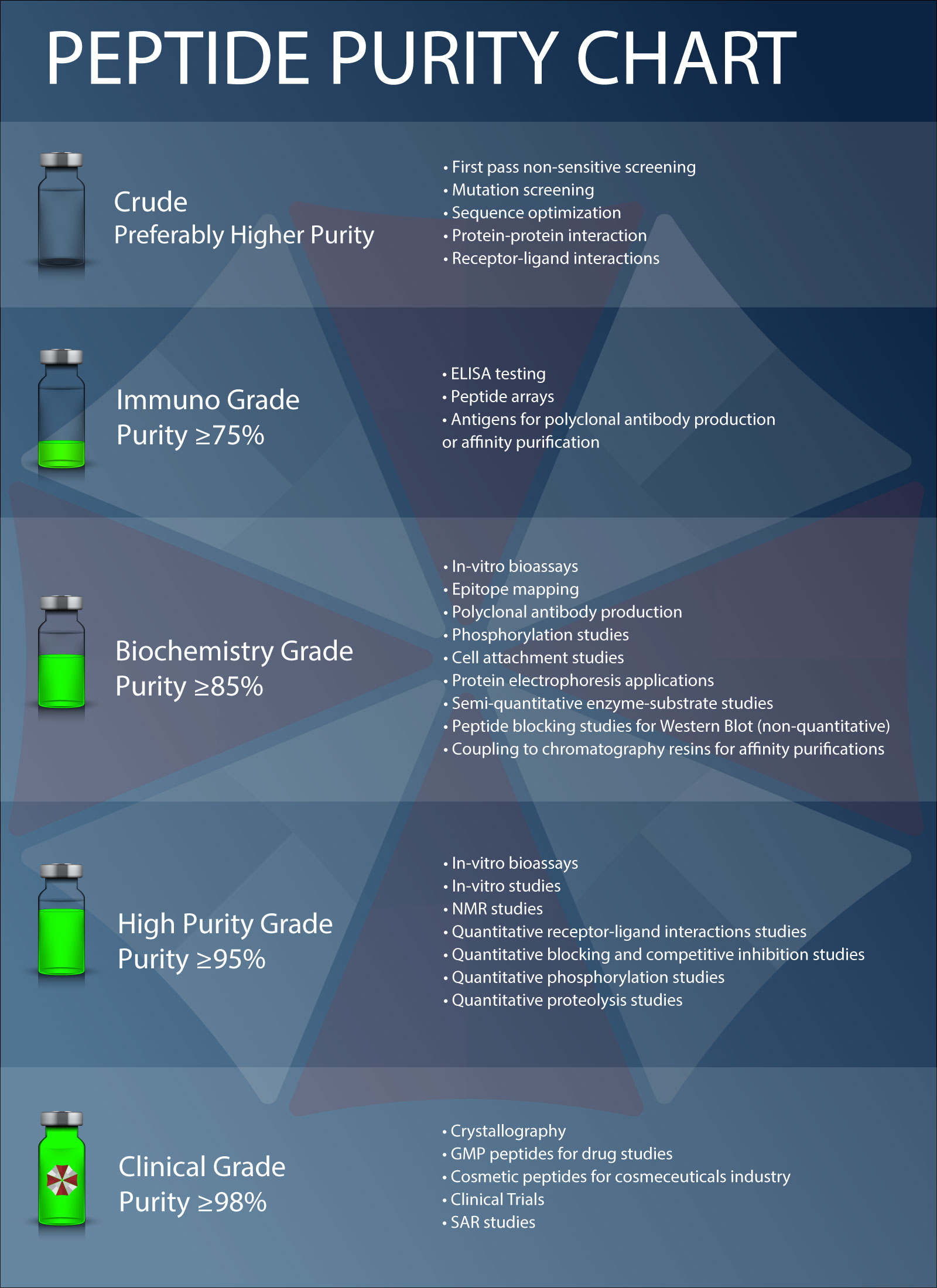
- Peptide pureness testing data are necessary in preclinical researches and must be included in investigational brand-new medicine (IND) applications and later on new drug applications (NDAs).
- We create logical workflows around the sample type, sequence functions, alteration account, and decision context.
- Recurring natural solvents, metal ions, or spin-offs from synthesis might trigger harmful side effects.
- Be cautious of COAs that provide a pureness number without any supporting chromatographic data, report pureness without defining the analytical approach, or listing a molecular weight without mass spectrometry confirmation.
What Do Purity Levels 95%, 98%, 99% Mean?
Unlike a maker's internal screening, independent third-party laboratory recognition is unbiased and offers objective outcomes, including credibility through unbiased analytical data. This procedure is critical for preserving high peptide quality since the peptide market is mainly uncontrolled in several places, and without recognition some providers may provide impure, mislabeled, and even phony peptides [3] Making sure that each set goes through correct laboratory testing aids validate the peptide's authenticity and purity, which is essential for both research study credibility and safety and security. Peptide purity refers to the portion of your sample that is the correct, full-length peptide sequence, devoid of other peptide-related impurities. For example, a purity of 98% shows that 98% of the peptide material is the intended item, while the other 2% may be undesirable remnants of synthesis (such as insufficient series or amino acid removal variants).Inadequate In Vivo/in Vitro Stability Data
The Tops
They are labeled "for research usage just" to make clear that they are meant for artificial insemination experiments or pet research studies, not for any kind of type of human use. As a matter of fact, a lab offering peptide testing need to deliver data fulfilling the stringent logical assumptions of agencies like FDA and EMA [4] By using a qualified third-party laboratory, peptide suppliers or scientists guarantee an unbiased and skillfully recorded analysis of high quality, which is specifically what assessors seek. Additionally, recurring independent screening sustains compliance in set release and quality control. Laboratory recognition for peptides means using scientific tests to confirm a peptide's identity, pureness, and structure. In practice, this usually entails third-party or independent screening by an outside lab to validate that a peptide item really contains what the tag asserts [2]HPLC steps chromatographic pureness by separating the target peptide from related impurities and calculating main-peak location percent. Mass spectrometry confirms molecular identification by inspecting whether the gauged mass matches the expected peptide mass. For research-grade peptide qualification, HPLC and LC-MS/ESI-MS answer different inquiries and must read together. BOC Sciences also gives comprehensive artificial insemination (cell systems) and in vivo (pet systems) screening solutions to aid clients completely recognize peptide formulation performance in various settings. In vitro examinations analyze peptide cytotoxicity, cell uptake, anti-inflammatory activity, and extra, offering fundamental data sustain for peptide applications in medical visual appeals and biomedical fields.
We have the ability of offering consumers from very early peptide drug exploration stages to peptide analysis. We offer all the technical details and directions for each and every action of peptide synthesis and analysis. The release procedure of peptide formulations is intricate, and an absence of scientific information prevents advancement. We develop in vitro release models, giving full release curves and kinetic design analysis to maximize item design. One of one of the most common sources of confusion in peptide jobs is utilizing various high quality terms as if they mean the exact same thing. Preserving a high degree of pureness is vital since contaminations can influence bioassays or reactions. For example, abbreviated peptides or chemically modified side-products might bind to targets or produce adverse effects that puzzle your outcomes. Specifically changed peptides or cyclic peptide series are hard to verify, which affects quality control. We integrate LC-MS/MS and chemical food digestion evaluation to precisely confirm the series and modification sites of non-natural changed peptides. Residual organic solvents, steel ions, or byproducts from synthesis may trigger hazardous adverse effects.